
“The Whole Internet Is Fandom Now”: An Interview with Abigail De Kosnik
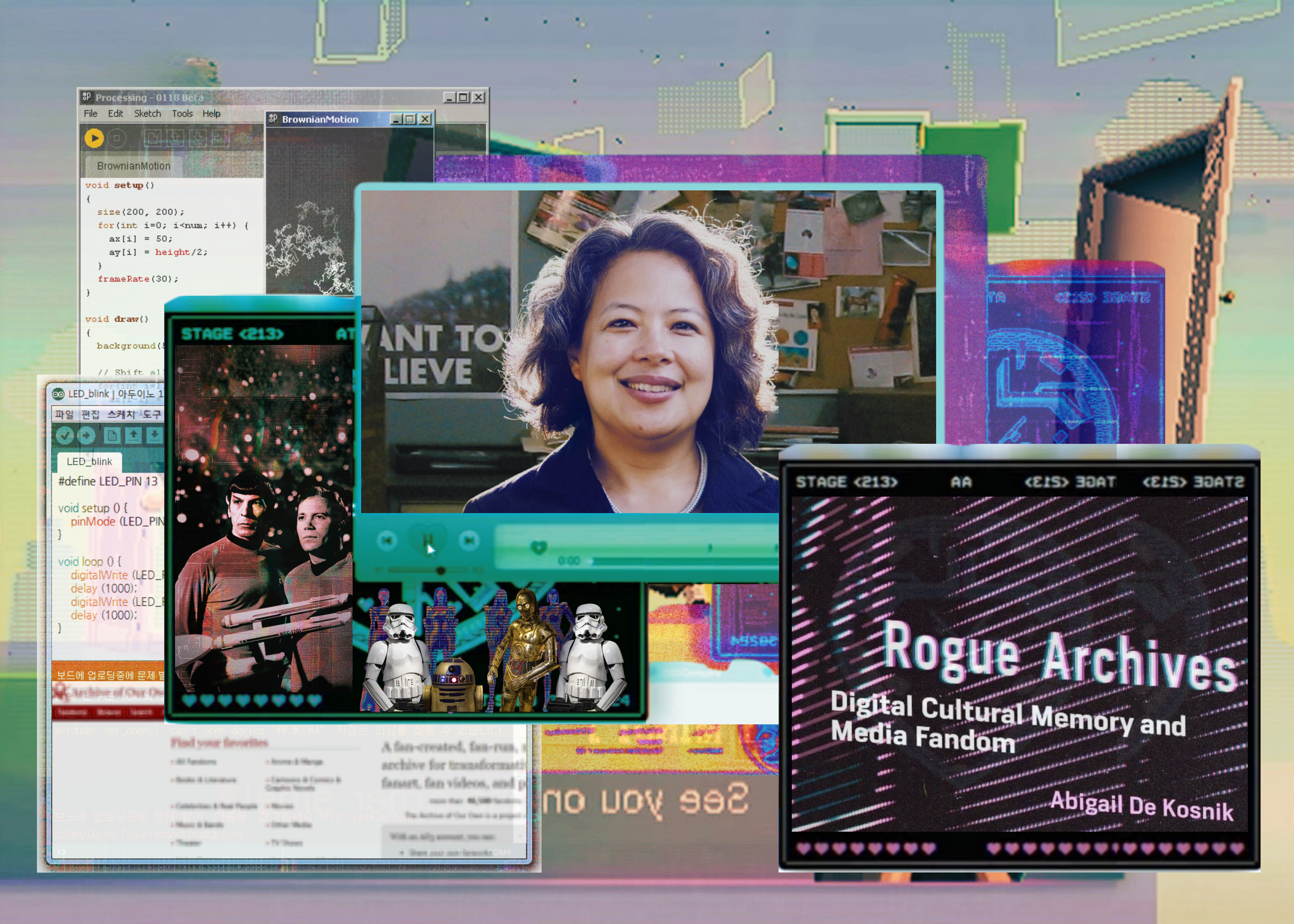
Image by Amber Lee. Incorporates elements from a photograph of Abigail De Kosnik; the cover of Rogue Archives: Digital Cultural Memory and Media Fandom by Abigail De Kosnik (MIT Press, 2016); screenshot from Archive of Our Own, October 11, 2021 (Wikimedia Commons); publicity photo of Leonard Nimoy and William Shatner, January 12, 1968 (NBC Television; Wikimedia Commons); Mulder’s office from The X-Files by Marcin Wichary, January 5, 2006 (Flickr; via Wikimedia Commons, CC BY 2.0); image of R2-D2 and C-3PO (PxHere, CC0); “A star wars stormtrooper,” 2016 (Pixabay; via PICRYL); “Processing screenshot” by Daniel Kallin, October 29, 2006 (Wikimedia Commons); “Arduino Fail Upload” by Dolicom, August 26, 2015 (Wikimedia Commons, CC BY-SA 4.0); music video for “RUDE!” by Hearts2Hearts, 2026; and music video for “New Jeans” by NewJeans, 2023.


This piece appears in print in MENT Issue 003; full digital publication is forthcoming. In the meantime, references associated with the piece are listed below.
Sources Referenced
Henry Jenkins, Textual Poachers: Television Fans and Participatory Culture.
Lisa A. Lewis, The Adoring Audience: Fan Culture and Popular Media.
Camille Bacon-Smith, Enterprising Women: Television Fandom and the Creation of Popular Myth.
Abigail De Kosnik, Rogue Archives: Digital Cultural Memory and Media Fandom.
Abigail De Kosnik, “Should Fan Fiction Be Free?”
Abigail De Kosnik, “‘Fifty Shades’ and the Archive of Women’s Culture.”
Miranda Jimmy, “Respecting Data Sovereignty Starts with the Stories We Tell about the Past.”
First Nations Information Governance Center, “The First Nations Principles of OCAP.”
Bill Kirkpatrick, “Media Policy.”